
By Gordon Cruise McBride
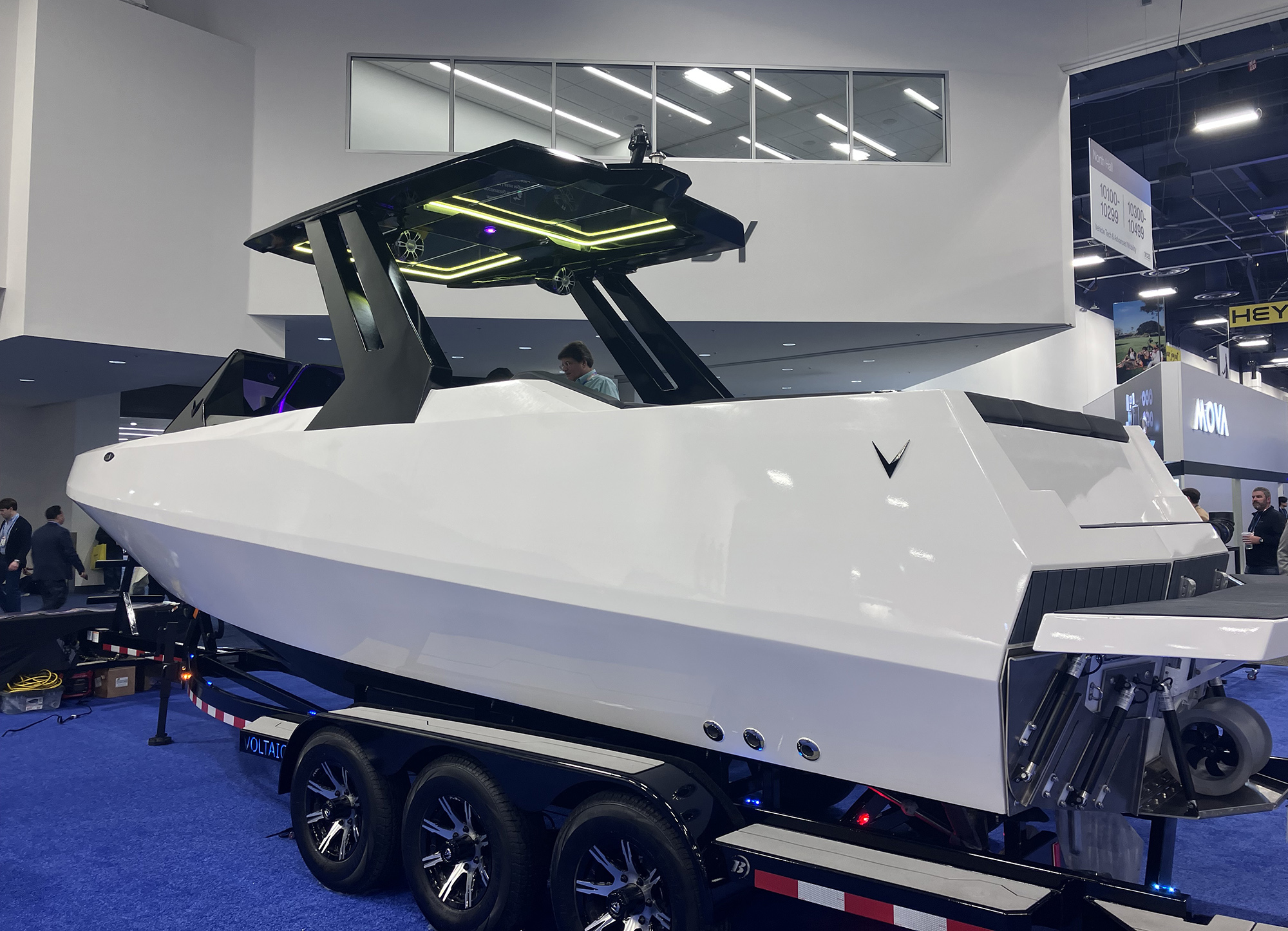
The CES 2026 exhibition in Las Vegas has come to a close for this year, and while walking my 30,000+ steps during the event, I came across a watercraft exhibit so striking that I had to stop and learn more… to “look under the hood” so to speak.
The company is called Voltaic Marine, based out of Traverse City, Michigan, and their flagship model is the AEW24: The Boat that Signals a Platform Revolution.
The Voltaic AEW24 represents a bold and carefully engineered step forward for electric propulsion in the recreational marine sector. Designed from the keel up as an all-electric watersports platform, the 24-foot AEW24 is not simply a conventional wake boat retrofitted with batteries and motors. Instead, it showcases an integrated electric drive system engineered to deliver consistent torque, predictable performance, and operational simplicity—qualities that are particularly critical in the demanding world of tow sports.
I spoke with Cody Covey, Chief Operating Officer of Voltaic, who explained that AEW stands for Aluminum Electric Watersports… Cody says that at the heart of the AEW24 is Voltaic Marine’s proprietary electric propulsion architecture, a system that combines high-output electric motors, large-format battery packs, and a sophisticated vessel control unit (VCU). Together, these components form a tightly coordinated drivetrain that fundamentally rethinks how power is generated, managed, and delivered on the water.
Instant Torque and Linear Power Delivery
Cody states that one of the most defining characteristics of the AEW24’s drive system is its electric motor output, rated at approximately 570 to 600 horsepower, depending on configuration. Unlike internal combustion engines, which must climb through a power band to reach peak torque, the AEW24 delivers maximum torque almost instantly, much like a Tesla. With reported torque figures approaching 2,000 lb-ft, the boat exhibits immediate thrust from a dead stop, a trait that directly benefits wakeboarding and surfing applications. All this, and at speeds up to 40mph!
This instant torque translates into exceptionally smooth and consistent pull. Riders experience fewer surges and drops in line tension, while the driver benefits from predictable throttle response regardless of speed or load. As a waterskier myself, I wish I had had this kind of power when I was first learning to ski.
Battery Architecture Built for Real-World Use
Supporting the high-output motors is a substantial battery system with up to 300 kWh of onboard energy storage. Rather than relying on a single monolithic pack, Voltaic employs a modular battery architecture that allows for scalability and redundancy. This approach improves system reliability while also enabling future upgrades as battery technology evolves.
From a technical standpoint, the battery system is engineered with active thermal management, an essential requirement for sustained high-load operation. Watersports demand repeated acceleration cycles, extended low-speed towing, and long periods of high draw—all conditions that can generate significant heat. Voltaic’s integrated cooling system helps maintain optimal battery temperatures, preserving performance consistency and extending battery lifespan, which is cost-effective in the long run.
In practical terms, the AEW24 is designed to support a full day of mixed-use operation, including towing, cruising, and idle time between runs. While range will naturally vary based on usage patterns, the system is clearly intended to eliminate the anxiety often associated with early electric boats.
 Intelligent Power Management
 Intelligent Power Management
Central to the AEW24’s advanced drive system is its vessel control unit (VCU). Acting as the brain of the propulsion system, the VCU continuously monitors motor output, battery state, thermal conditions, and throttle inputs. This real-time data processing allows the system to dynamically balance performance and efficiency without driver intervention.
One of the most notable advantages of this approach is how seamlessly the boat transitions between operating modes. Acceleration is strong but controlled, cruising is quiet and efficient, and low-speed maneuvering benefits from precise motor modulation. The absence of gear changes, engine vibration, and exhaust noise fundamentally alters the driving experience, making it more refined and less fatiguing over day-long outings with friends and family.
Additionally, while only 24’ in length, the AEW24 is equipped with bow and stern thrusters that integrate directly into the electric drive architecture. These thrusters provide exceptional low-speed control in marinas and tight spaces, further highlighting how electrification can enhance, rather than complicate, boat handling.
Efficiency Meets Performance
From an efficiency standpoint, the AEW24 demonstrates how electric propulsion can be both powerful and practical. Electric motors operate at significantly higher efficiency levels than combustion engines, converting a greater percentage of stored energy into usable thrust. This efficiency is especially evident during steady towing speeds, where the boat can maintain consistent output with minimal energy waste. With no engine roar or exhaust resonance, onboard communication improves, rider cues are easier to hear, and for lakes with noise restrictions or environmentally sensitive areas, this quiet operation is a substantial advantage.
 Maintenance and Longevity Considerations
 Maintenance and Longevity Considerations
Another strength of the AEW24’s drive system is its mechanical simplicity. Electric motors have far fewer moving parts than internal combustion engines, eliminating oil changes, fuel system maintenance, and many common failure points. Over time, this simplicity has the potential to reduce both maintenance costs and downtime, an important consideration for owners who prioritize reliability.
Ultra-modern Cockpit
Sitting at the starboard helm, Cody’s teammate Michael explained the high-tech cockpit array, and that the company chose Garmin because of their robust foundation for integrating systems. He demonstrated how he was able to control all boat systems, lighting, controls, power monitoring, etc. The joystick controls both bow and stern thrusters, making manoeuvring and docking an easy task, even for novice boaters.
If you are like me, a technology-focused boater, the AEW24 offers a compelling vision of what electric boating can achieve when engineering priorities are aligned with actual on-water use. While walking around the stern of the boat to thank Cody for the tour at the event, I noticed that there was no corporate name emblazoned on the transom of his boat like so many others, and he explained that they wanted to go with a clean look, assuring me that the sleek lines of the AEW24 will certainly turn heads when you pull up to the marina. I have no doubt…
SPEC SHEET
- Length: 24 Feet
- Beam: 8.5 feet
- Draft: 2.5 feet
- Towable Weight: Under 10,000 lb
- Capacity: 18 people
- Hull Material: Aluminum
- Top Speed: 40 mph
- Cruising Speed: 25 mph
- Runtime: Up to 8 hours on a single charge
- Charging Time: Fast charge up to 80% in ~3 hours
- Power Output: 570 hp (425 kW)
- Torque: 1900 ft-lb (2700 Nm)
- Battery: 300 kWh